New EASAC Commentary: Nature Restoration is a Strategic Investment in Europe’s Security, Prosperity, and Ecological Stability#
Europe faces rising climate-related damage costs, growing pressure on public finances, and renewed debates over competitiveness and security. Fully implementing the EU Nature Restoration Regulation is a strategic investment in Europe’s health, security, and economic resilience - not simply a legal obligation - according to a new scientific commentary from the European Academies Science Advisory Council (EASAC).
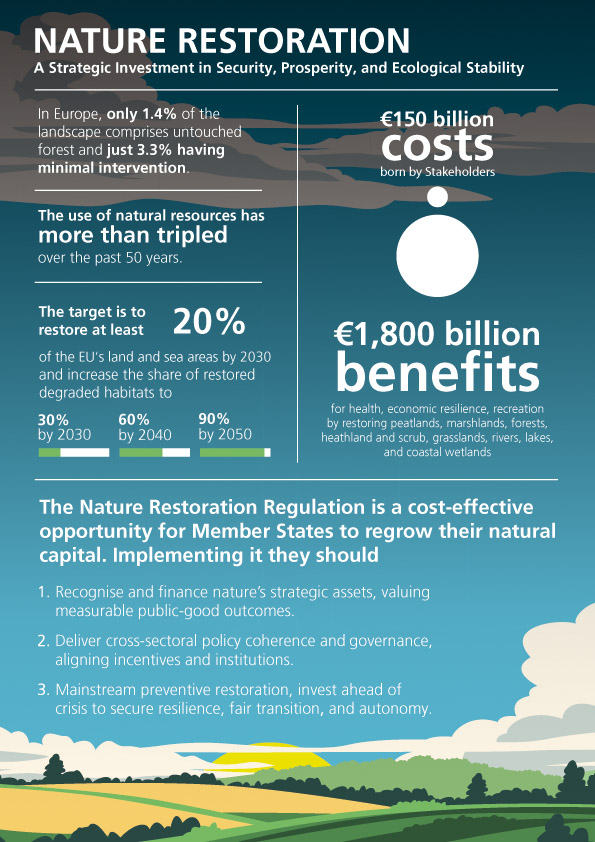
150 billion versus 1.8 trillion
The Commentary finds that the estimated cost of restoring Europe’s degraded ecosystems - around EUR 150 billion - is outweighed by benefits at least ten times higher, through avoided disaster losses, improved public health, greater climate resilience, and strengthened food and water security.
“Nature restoration is not an environmental luxury. It is basic risk management,” says Prof Thomas Elmqvist, EASAC Environment Director and lead author*. “At a time when Europe is spending billions responding to floods, droughts, wildfires, and health impacts, restoring ecosystems is among the smartest preventive investments we can make.”
Degraded nature is increasing Europe’s exposure to risk
Europe’s natural systems are already heavily degraded. Only 1.4% of Europe’s forests remain untouched, and just 3,3% of land experiences minimal human intervention, according to the Commentary. These losses are directly linked to rising flood damage, declining soil fertility, weakened forest carbon sinks, and growing wildfire risk.
Long-standing economic models that treat nature as expendable no longer reflect scientific evidence. Healthy ecosystems underpin our economy. They protect infrastructure, stabilise food systems, and reduce public spending on disaster response and healthcare. “Ignoring the economic role of nature is a serious economic and strategic mistake,” says Elmqvist. “Neo-classical economics continues to downplay the role of nature and biodiversity in economic development. But when ecosystems fail, the costs are borne by citizens, insurers, and governments.”
The Commentary identifies immediate, high-impact restoration actions in three key ecosystems
- Agricultural landscapes. Regenerative agriculture can restore soil organic matter, biodiversity, water retention, and climate resilience while sustaining yields. Priorities include diversified crop rotations and intercropping, cover and perennial crops, reduced tillage, agroforestry, landscape elements, and integrated pest management (IPM). Policies should reward measured outcomes including carbon stored in soil, biodiversity, and water regulation gains.
- Forests. The forest carbon sink is weakening due to climate stress and harvest pressure. Close-to-nature forestry, mixed-species and mixed-age stands, habitat protection, and landscape-level fuel management can reduce wildfire risk and rebuild resilience. Bioenergy incentives should prioritise genuine residues and cascading use of biomass, while restoring forest carbon stocks to meet land use, land use change and forestry LULUCF targets.
- Peatlands. Rewetting drained peatlands can sharply cut emissions, lower wildfire risk, improve water retention, and restore biodiversity.
The Commentary highlights three core messages:
- Treat and finance nature as a strategic asset. Europe’s natural assets - soils, biomass, peatlands, wetlands, rivers, and marine ecosystems - are essential for carbon storage, water regulation, biodiversity, and food and energy security. These assets must be systematically recognised, measured, and financed as strategic priorities.
- Deliver cross-sectoral policy coherence and governance. Nature restoration cannot be delivered in isolation. It requires coherence across agriculture, forestry, water, energy, marine, and urban systems, supported by clear institutional mandates and accountability.
- Mainstream preventive restoration as the most effective and efficient way to reduce disaster risks, protect assets, shield our economy against climate extremes, and enhance Europe’s resilience and strategic autonomy.
A warning against policy backsliding
EASAC warns that weakening or delaying the Nature Restoration Regulation’s implementation would increase Europe’s exposure to climate extremes, economic losses, and health impacts. „As scientists, we are alarmed by the accelerating reversal of critical environmental and climate protections. Environmental rollbacks do not eliminate costs, rather, they merely shift them forward. It is vital that Member States concentrate on fulfilling the Regulation's objectives instead of seeking to weaken its provisions,“ says Prof Fiona Regan, Co-Chair of EASAC’s Environment Steering Committee.
Download the commentary

EASAC has analysed several of the related issues and the science that underpins the regulation. The Commentary
 has been drawn up by Prof Thomas Elmqvist MAE and members of the Environment Steering Panel. It updates previous analyses to inform on key issues related to the regulation.
Contacts:
Prof Thomas Elmqvist MAE Thomas.elmqvist@easac.eu
Prof Fiona Regan fiona.regan@dcu.ie
Prof András Báldi MAE baldi.andras@ecolres.hu
About the European Academies Science Advisory Council (EASAC)#
EASAC is formed by the national science academies of the EU Member States, Norway, Switzerland and United Kingdom, to collaborate in giving advice to European policymakers. Through EASAC, the academies work together to provide independent, expert, evidence-based advice about the scientific aspects of European policies to those who make or influence policy within the European institutions.